In questa pagina
A hotel slipper fits when your heel rests on the footbed, your toes have comfortable space and the upper holds your foot without squeezing it. If you have to grip with your toes to keep it on, or your heel hangs over the back, the pair is not a good everyday fit simply because the packaging says one size.
Start with the shape and measurements of the actual slipper. A room amenity is often designed to serve a range of guests, but that does not make every pair suitable for every foot. You can recognise a poor fit without knowing specialist footwear terminology.
Put the whole foot on the footbed
Place the slipper on a clean, dry floor and slide your foot in normally. Do not push hard into the front to make the heel appear to fit. Your foot should settle into a natural position with the upper resting comfortably over it.
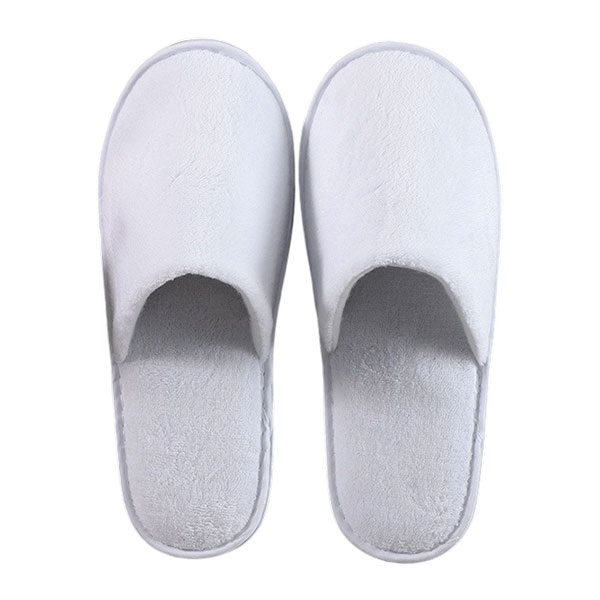
Look down at the heel. It should be supported rather than sitting across the back edge. Then check the sides of the forefoot. A sole that is technically long enough can still be too narrow where your foot is widest. The upper may hide that mismatch in a top-down photograph, so inspect the sides as well.
For an open-toe design, notice whether the toes approach or cross the front edge when you take a normal step. For a closed-toe design, check for contact at the toe ends. Do not use a pair that requires you to curl your toes or change how you place your foot just to remain inside it.
Measure length without converting it into a shoe size
Slipper listings sometimes provide an outside sole length. Your familiar shoe size refers to a sizing system and a different type of fit. Those figures cannot be treated as interchangeable. A slipper described as a certain length may have less usable room inside, depending on its shape and construction.
Stand on a sheet of paper if you want a simple reference measurement, then mark the heel and longest toe while keeping the foot comfortably placed. Measure both feet, since the larger measurement is often the more useful reference. This gives you a question to ask the supplier rather than an automatic size conversion.
Ask whether the published figure describes the outside sole, inner footbed or recommended foot length. If only one size is available and the answer still leaves the fit uncertain, look for an alternative rather than hoping that a soft upper will stretch into the right shape.
Width changes how secure the upper feels
Two feet with similar lengths can need different widths. The upper must allow the foot to enter and rest comfortably, while still holding it well enough for ordinary indoor walking. A wide upper on a narrow foot may leave the wearer shuffling. A tight upper on a broad foot may prevent the heel from reaching the intended position.
Watch for a pair that feels acceptable while you stand still but slides forward as soon as you move. The problem may be volume over the foot rather than sole length. Equally, a pair can look generous at the front while pressing uncomfortably across the top.
Il closed-toe coral fleece hotel slipper shows one available shape in the site’s collection. Confirm what the listed length and width mean before using them for fit. A product photo is useful for seeing the closed toe and general profile; it cannot confirm your individual fit.
Walk a few ordinary indoor steps
A fitting check should include gentle movement on a clean, dry, suitable indoor surface. Walk at your usual pace, turn carefully and notice whether the slipper follows the foot. You should not need exaggerated toe gripping or an unusually short stride to stop it coming off.
If the upper twists, the heel moves sideways, or one foot repeatedly slips out, stop the trial. Adjusting the way you walk is not a sensible long-term solution to a poor-fitting amenity. Choose a different size or a different pair when available.
This check does not establish slip resistance or suitability for wet areas. Fit and traction are separate questions. Follow the venue’s footwear rules and the product’s intended use. A comfortable slipper is still not automatically appropriate for a wet shower floor, poolside surface or staircase.

Use this fit checklist instead of the one-size label
The label is a starting description. Your foot and the actual garment-like upper tell you whether the pair works. Notice the point at which the fit fails, because that gives you a more useful alternative to request.
| What you notice | A possible fit issue | What to do next |
|---|---|---|
| Heel rests partly beyond the back | Insufficient usable length or foot pushed too far back | Try an appropriate larger or differently shaped pair |
| Toes press against a closed front | Too little toe space | Stop forcing the foot forward and check another size |
| Foot slides forward with each step | Upper too loose for the foot | Look for a closer-fitting shape rather than toe gripping |
| Upper presses across the top | Too little room over the foot | Compare a wider or roomier upper |
| Foot sits across the side edges | Sole shape too narrow | Choose a wider footbed rather than length alone |
The observations are not a medical assessment. If normal footwear is uncomfortable for a reason that concerns you, get individual advice from an appropriate professional. For an ordinary hotel stay, there is no need to keep wearing an unsuitable pair just because it was provided in the room.
Think about socks before you make the final check
Try the slippers the way you expect to wear them. Bare feet and thick socks occupy different amounts of space. Socks can make a previously comfortable upper feel tight, while a very loose pair may still be unstable even after you add a thicker layer.
Do not use socks to rescue a visibly wrong sole length. They do not move the heel edge or create a wider footbed. They may also change how the foot moves against the lining. If the slipper only stays on with a carefully chosen sock, it may not be the convenient room footwear you wanted.
For visitors at home, avoid assuming that everybody will use the same type of sock or have the same foot shape. If you provide guest slippers, offer reasonable size choices where possible, keep the clean pairs clearly separate, and let people use their own suitable indoor footwear if they prefer.
Look beyond the fluffy surface
The outer fabric is only one part of the slipper. An appealing plush surface does not tell you the sole’s usable dimensions, the space under the upper or the care instructions for the complete item. Pressing the slipper in your hand is not a substitute for checking it on the foot.
Read any composition and use information that comes with the pair. If a sole is described as EVA, that names a material rather than certifying a particular grip level or the suitability of the assembled slipper for every room. Avoid treating a material label as a promise about performance.
For a general overview of the category, Wikipedia’s slipper entry describes several forms of light indoor footwear. It helps explain why the word slipper covers very different shapes. Choose based on the specific pair, rather than assuming that advice about one shape applies to all of them.
A useful pair should disappear into the routine
After the basic checks, ask one final question: can you walk normally without thinking about keeping the slipper on? A pair that constantly needs attention defeats much of the convenience of room footwear. Comfortable fit should make an ordinary indoor routine easier.
If you are buying rather than using a supplied pair, keep the packaging and order details until you have checked the fit in a way permitted by the seller’s policy. Do not wash, alter or wear it outdoors before deciding whether it is suitable. Ask about the relevant policy before ordering if sizing is uncertain.
For the site’s available slipper style, the form below can be used to request clarification about dimensions, size options and intended use. Give your question in terms of footbed length, width or upper room. That is more likely to produce a useful answer than asking whether a one-size pair fits everyone.
Should my heel be right on the back edge?
Your heel should rest on the intended footbed with comfortable support. If it hangs over or presses awkwardly across the edge, the pair may be too short or the upper may be preventing your foot from settling correctly. Check the whole shape rather than one measurement.
Can a closed-toe hotel slipper stretch to fit?
Do not rely on stretching to create missing length or width. Materials and construction differ, and a soft upper can still press against the toes. If the pair is uncomfortable during a simple clean, dry trial, ask for a more suitable size or use your own footwear.
Does a thicker sole mean a better fit?
Sole thickness and fit describe different things. A thick sole can still be too narrow, too short or paired with a loose upper. Assess foot position and walking comfort separately from cushioning and any surface-use claims.
Are hotel slippers suitable for a wet bathroom?
Do not assume so. Follow the product instructions and the venue’s guidance for wet areas. A description such as textured sole does not establish that the pair will provide reliable traction on every wet surface. Use footwear intended for the specific setting.
What measurements should I request online?
Ask whether the published dimensions refer to the outer sole or usable inner area, and request available size options. Footbed width and upper shape matter as well as length. Provide the intended use so the seller can answer about the actual product rather than a generic shoe-size conversion.